A complete guide to Alibaba.com B2B sourcing, Verified Suppliers, Trade Assurance escrow, Cainiao global logistics, Alibaba Cloud infrastructure, and modern supply chains.
Testing Methodology: Evaluated against published RFC protocols, algorithmic complexity proofs, and verified production source code.
Test Environment: Evaluated against published RFC protocols and production systems telemetry
// COMMERCIAL TRANSPARENCY:
Partner links may generate a commission. Rankings and benchmarks cannot be purchased. Read FTC policy.
// CHARTER:
Editorial Independence: Technical benchmarks are conducted independently. Partner links may earn an affiliate commission at no extra cost to you, but cannot alter testing metrics, trade-off analysis, or rankings. Editorial Policy · FTC Transparency Disclosure.
Introduction
In today's digital economy, businesses are no longer limited to purchasing products from manufacturers in their own countries. A small business can connect with a factory in China, negotiate bulk prices, customize products with its own branding, and arrange international shipping without having to visit the manufacturer physically. One of the major platforms making this possible is Alibaba.
Alibaba Group has developed a large technology ecosystem that connects businesses, manufacturers, wholesalers, logistics providers and digital service companies. Two important parts of this ecosystem are Alibaba.com, its global B2B e-commerce marketplace, and Alibaba Cloud, its cloud computing and artificial intelligence platform.
While Alibaba.com focuses on connecting buyers with suppliers and simplifying international trade, Alibaba Cloud provides the computing infrastructure and enterprise technologies needed to operate large-scale digital businesses.
Together with Cainiao's logistics network, these services demonstrate how technology can transform traditional commerce into a more connected and efficient global business system.
1. Understanding Alibaba.com and Alibaba Cloud
Alibaba.com: A Global B2B Marketplace
Founded in 1999, Alibaba.com was established to help businesses connect with manufacturers and suppliers across international markets. Unlike consumer shopping websites, which mainly focus on individual purchases, Alibaba.com primarily supports business-to-business (B2B) transactions.
The platform connects:
Manufacturers and factories looking for international customers.
Wholesalers supplying products in large quantities.
Retailers purchasing inventory for resale.
Small and medium-sized enterprises (SMEs) looking for affordable sourcing options.
Importers and exporters involved in international trade.
Businesses can search for products, compare suppliers, request quotations, negotiate prices and place orders through the platform.
One of its biggest advantages is the ability to communicate directly with manufacturers. This allows buyers to negotiate minimum order quantities (MOQs), request product samples, discuss packaging and develop customized products.
Alibaba.com also provides services such as supplier verification, online payment protection, digital marketing, order management and logistics support.
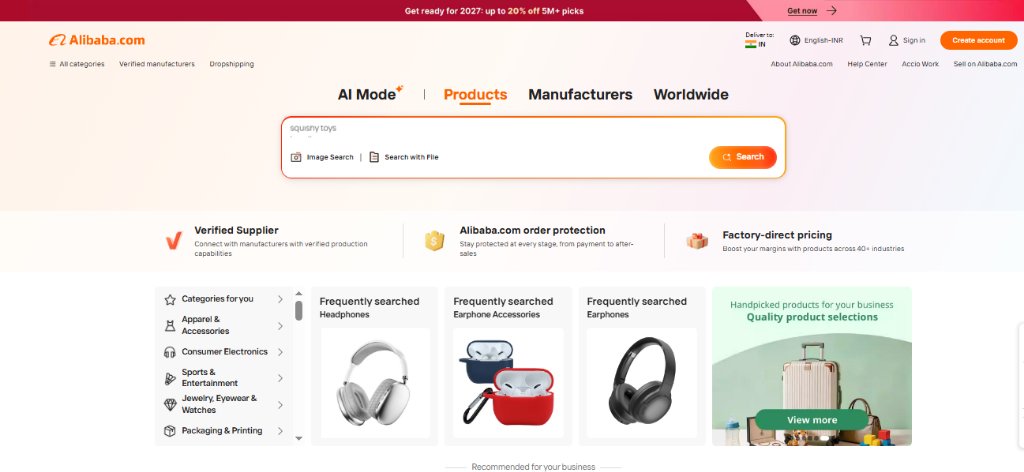
Alibaba.com // Global B2B Marketplace
Alibaba.com B2B portal showcasing AI Mode, Products, Manufacturers, Verified Supplier badges, order protection, and factory-direct pricing across 40+ industries.Source: Alibaba.com Homepage
Alibaba Cloud: Infrastructure for Digital Businesses
Alibaba Cloud is the cloud computing division of Alibaba Group. It provides businesses with access to computing resources, databases, storage, networking, cybersecurity and artificial intelligence services.
Instead of purchasing and maintaining expensive physical servers, companies can use Alibaba Cloud to host applications, websites, databases and business systems.
Its services are broadly divided into three categories:
Infrastructure as a Service (IaaS): Provides computing power, storage and networking resources.
Platform as a Service (PaaS): Provides development environments, databases and application management tools.
Model as a Service (MaaS): Provides access to AI models and related development capabilities.
Alibaba Cloud supports applications ranging from e-commerce websites and financial services to enterprise data management and artificial intelligence.
The technology behind Alibaba's large shopping ecosystem has also helped the company develop cloud solutions for businesses that need to manage extremely high traffic and large volumes of transactions.
2. B2B Global Trade Infrastructure: Building Trust Between Buyers and Suppliers
International trade involves several challenges. Buyers may be purchasing products from manufacturers located thousands of kilometres away, making it difficult to physically inspect factories, verify business information or monitor production.
Alibaba.com addresses some of these challenges through its digital trade infrastructure.
A. Verified Suppliers and Business Verification
Alibaba.com provides supplier verification services to help buyers evaluate potential business partners.
A Verified Supplier has undergone third-party assessment of aspects such as its company profile, management systems, production capabilities and manufacturing processes.
These assessments help buyers understand whether a supplier has the facilities and business capabilities it claims to possess.
However, verification should not be treated as a complete guarantee of product quality. Buyers should still request samples, inspect certifications and evaluate the supplier's previous work.
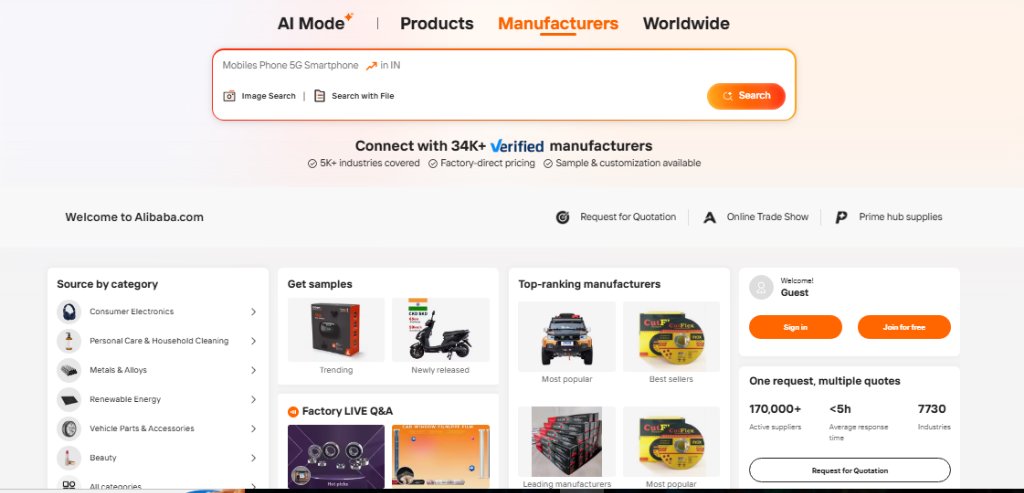
Alibaba.com // Verified Suppliers & RFQ
Manufacturers directory featuring 34K+ verified suppliers, factory-direct samples, live factory Q&A, and Request for Quotation (RFQ) matching across 7,730 industries.Source: Alibaba.com Manufacturers
B. Trade Assurance: Protecting International Transactions
One of Alibaba.com's important features is Trade Assurance.
It is designed to reduce the risks associated with international business transactions by providing payment protection and a dispute-resolution mechanism.
The basic process works as follows:
The buyer and supplier agree on product specifications, quantity, price and delivery requirements.
A Trade Assurance order is created on Alibaba.com.
The buyer makes payment through an eligible platform-supported payment method.
The payment is held through Alibaba's escrow-based protection process.
The supplier manufactures and ships the products according to the agreed terms.
The payment is released according to the order's applicable confirmation and protection conditions.
If the supplier fails to meet the agreed product quality or delivery requirements, the buyer can raise a dispute and request an eligible refund or compensation.
An important point is that Trade Assurance protection depends on the actual order terms and payment arrangements. Payments made outside the eligible platform process may not qualify for the same protection.
C. Escrow and Secure Payments
Escrow is a financial arrangement in which money is held by an intermediary until specified conditions are fulfilled.
In Alibaba.com's Trade Assurance system, this helps reduce the risk of buyers paying suppliers without receiving the agreed products.
For example, consider a retailer purchasing 1,000 electronic accessories from a manufacturer.
Instead of transferring the entire payment directly to an unknown supplier, the buyer can use an eligible Trade Assurance order. The payment is handled through the platform's protection process, and the supplier receives the funds according to the agreed transaction conditions.
This creates greater confidence between international buyers and sellers.
D. Global Logistics Through Cainiao
Payment and supplier verification are only two parts of international trade. Products must also move from factories to warehouses, distribution centres and final destinations.
This is where Cainiao becomes important.
Founded in 2013, Cainiao is Alibaba Group's logistics and supply chain technology business. It provides international shipping, warehouse management, cross-border delivery and digital logistics services.
Its infrastructure includes:
International express delivery.
Overseas warehousing and inventory management.
Cross-border freight services.
Digital shipment tracking.
Customs clearance coordination.
Automated sorting and warehouse technologies.
Reverse logistics and returns management.
Cainiao uses technologies such as artificial intelligence, automation and the Internet of Things (IoT) to improve the efficiency of logistics operations.
Its network connects different logistics partners and transport systems, helping businesses coordinate shipments across international markets.
For companies sourcing products from overseas manufacturers, this integration can make the movement of goods easier to manage.
3. Alibaba Cloud: Infrastructure, Scalability and Enterprise Solutions
Modern online businesses must handle large amounts of data, customer requests, payments and product information. During major shopping events, traffic can increase dramatically within a short period.
Traditional IT infrastructure may struggle to handle such sudden increases in demand.
Alibaba Cloud addresses this problem through scalable cloud computing technologies.
A. Cloud Infrastructure and Computing Resources
Alibaba Cloud provides a range of services that allow businesses to build and manage digital infrastructure.
Some important services include:
Elastic Compute Service (ECS): Provides virtual computing resources that businesses can use to host websites, applications and other workloads.
Object Storage Service (OSS): Provides scalable storage for images, videos, documents, backups and other digital files.
Server Load Balancer: Distributes incoming network traffic across multiple servers to improve availability and performance.
ApsaraDB: Provides managed database services for storing, processing and retrieving business information.
Content Delivery Network (CDN): Distributes website content through geographically distributed servers to reduce loading times for users.
These services can work together to create an infrastructure that supports websites, mobile applications, payment systems and enterprise software.
B. How Alibaba Cloud Handles Singles' Day
One of the best examples of Alibaba Cloud's scalability is China's Singles' Day shopping festival, also known as Double 11.
Held annually on November 11, Singles' Day has become one of the world's largest online shopping events.
During this event, millions of customers access shopping platforms, browse products, place orders and make payments within a limited period.
This creates enormous pressure on servers, databases, payment systems and network infrastructure.
Alibaba Cloud helps manage this demand through several technologies:
Elastic computing: Computing resources can be increased to support higher traffic.
Load balancing: Incoming requests are distributed across available servers.
Distributed databases: Large volumes of transaction information can be processed across distributed systems.
Content delivery networks: Product images and other content can be delivered efficiently to users.
Real-time monitoring: System performance and potential failures can be monitored continuously.
Fault recovery: Infrastructure is designed to improve system availability and reduce service interruptions.
A notable example occurred during the 2020 Singles' Day festival. Alibaba reported a peak of 583,000 transactions per second, demonstrating the scale of its cloud infrastructure.
In 2021, Alibaba also reported that the festival's systems had moved entirely to cloud-native technologies, reducing computing resources required per 10,000 transactions by 50% compared with the previous year.
These examples demonstrate why cloud scalability is important for businesses experiencing sudden increases in digital activity.
C. Enterprise Software and Business Applications
Alibaba Cloud is not limited to providing virtual servers. It also offers technologies that help organizations manage their everyday operations.
Its enterprise services cover areas such as:
Database and data analytics.
Artificial intelligence and machine learning.
Cybersecurity and identity management.
Application development and deployment.
Enterprise networking.
Data backup and disaster recovery.
Big data processing.
Cloud-based business applications.
For example, an e-commerce company can use cloud databases to maintain customer records, analytics tools to understand buying behaviour, and AI services to improve product recommendations.
Similarly, manufacturing companies can use cloud-based data systems to monitor inventory, production schedules and supply chain operations.
The advantage is that businesses can access these technologies without having to independently develop every component of their IT infrastructure.
4. Supply Chain and Sourcing: From Factory to Online Store
One of Alibaba.com's most useful applications is direct-to-factory sourcing.
Traditionally, retailers purchased products through several intermediaries, including distributors, wholesalers and local agents. Each intermediary could add additional costs to the final product.
Direct sourcing allows businesses to communicate with manufacturers and negotiate purchasing arrangements more directly.
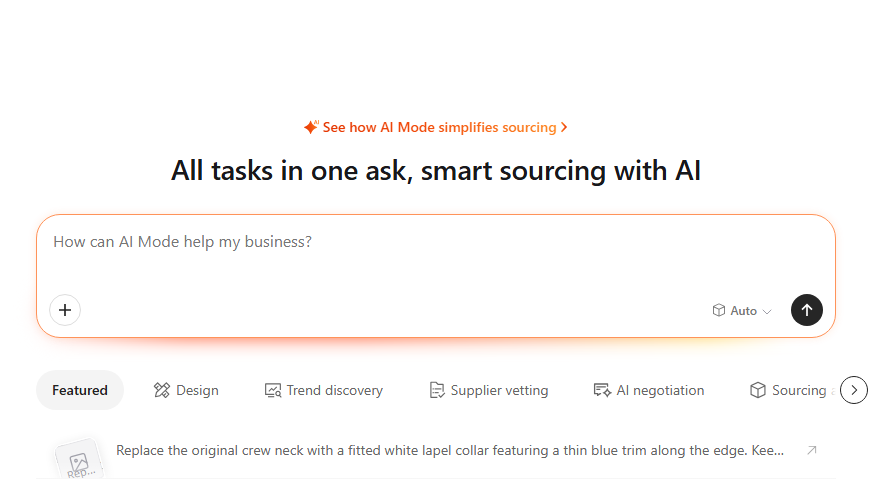
Alibaba.com // Smart Sourcing with AI
Alibaba AI Mode interface simplifying product sourcing with Design, Trend discovery, Supplier vetting, AI negotiation, and intelligent sourcing workflows.Source: Alibaba.com AI Mode
A. How Direct-to-Factory Sourcing Works
The process generally involves the following stages:
Step 1: Product Research
The buyer identifies a product that has potential demand in their target market.
For example, an online retailer may want to sell reusable water bottles.
Step 2: Finding Manufacturers
The retailer searches Alibaba.com for manufacturers offering reusable bottles and compares their product specifications, prices, MOQs and supplier credentials.
Step 3: Requesting Quotations
The buyer contacts shortlisted manufacturers and requests quotations.
An RFQ (Request for Quotation) can include:
Required product quantity.
Material specifications.
Product dimensions.
Packaging requirements.
Customization requirements.
Shipping destination.
Expected delivery timeline.
Step 4: Samples and Quality Checks
Before placing a large order, the buyer requests product samples.
Samples help evaluate material quality, durability, appearance and manufacturing standards.
Third-party inspections can also be arranged before shipment.
Step 5: Negotiation and Ordering
After selecting a suitable supplier, the buyer negotiates pricing, production time, payment conditions and shipping arrangements.
A detailed purchase order should document all important specifications.
Step 6: Manufacturing and Shipping
The manufacturer produces the order and prepares it for shipment.
The products can then be transported through suitable international logistics providers, including services available through Alibaba.com's logistics ecosystem.
Step 7: Selling to Customers
Once the products reach the retailer's warehouse, they can be listed on an e-commerce website or marketplace and sold to customers.
This process helps businesses establish their own product supply chains.
B. Private Labelling and Product Customization
Private labelling is a business model in which a company sells products manufactured by another company under its own brand name.
Alibaba.com can support this model by connecting businesses with manufacturers that offer customization services.
For example, a new skincare accessories brand may source cosmetic storage containers from a manufacturer and request:
Its own brand logo.
Custom packaging.
Specific colours.
Different product sizes.
Customized product labels.
The manufacturer produces the products according to the agreed requirements, while the retailer focuses on branding, marketing and distribution.
This approach allows businesses to develop their own product identity without establishing manufacturing facilities.
However, businesses should ensure that product labelling, intellectual property rights, safety requirements and applicable import regulations are properly addressed.
C. Dropshipping Through Alibaba Suppliers
Dropshipping is an e-commerce model in which a seller accepts customer orders without keeping the products in their own inventory.
When a customer purchases a product, the seller arranges for a supplier to ship it directly to the customer.
Alibaba.com can help businesses discover manufacturers and suppliers that may support customized fulfilment arrangements.
However, Alibaba.com is primarily a wholesale B2B marketplace, not a dedicated dropshipping fulfilment platform.
Businesses interested in dropshipping should confirm whether a supplier:
Accepts single-unit orders.
Offers low or zero MOQs.
Supports individual customer shipments.
Provides neutral or customized packaging.
Can handle international shipping.
Offers reliable order tracking.
Can integrate with the seller's e-commerce system.
For businesses planning to operate at a larger scale, it is also important to calculate shipping costs, delivery times, customs duties and return-handling expenses.
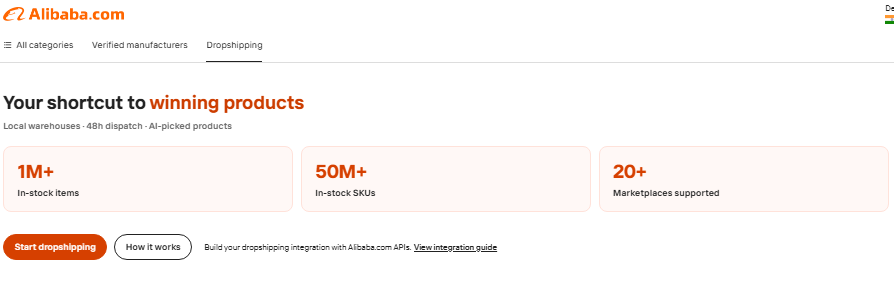
Alibaba.com // Dropshipping Solutions
Alibaba.com Dropshipping portal offering 1M+ in-stock items, 50M+ SKUs, 48-hour dispatch from local warehouses, 20+ supported marketplaces, and API integrations.Source: Alibaba.com Dropshipping
5. Business Models: How Alibaba Creates Value
Alibaba's ecosystem operates through several connected business models.
Alibaba.com Revenue Model
Alibaba.com generates revenue through services provided to sellers and businesses.
These include:
Supplier membership plans.
Premium storefront and listing services.
Digital advertising and product promotion.
Customer relationship management tools.
Transaction-related and value-added services.
Logistics and supply chain solutions.
The marketplace connects buyers and sellers, while additional services help suppliers improve their visibility and manage their businesses.
Alibaba Cloud Revenue Model
Alibaba Cloud follows a cloud services business model.
Businesses pay for computing resources and other services based on their selected plans and usage arrangements.
Its revenue-generating services include:
Cloud computing and storage.
Database management.
Networking services.
Cybersecurity.
Artificial intelligence solutions.
Enterprise technology services.
This model allows companies to access advanced computing infrastructure without making large initial investments in physical IT equipment.
Cainiao's Logistics Model
Cainiao provides logistics and supply chain services through a combination of its own infrastructure and partnerships with logistics companies.
Its services include international transportation, warehousing, fulfilment, tracking and delivery coordination.
Together, these business models create an ecosystem in which sourcing, technology and logistics support different stages of global commerce.
6. Advantages and Challenges of Using Alibaba
Advantages
Global supplier access: Businesses can discover manufacturers and wholesalers from different countries.
Competitive sourcing: Direct communication with manufacturers can help businesses negotiate prices and product specifications.
Customization: Private labelling and product development allow companies to establish their own brands.
Transaction protection: Trade Assurance provides an additional layer of protection for eligible orders.
Scalable technology: Alibaba Cloud provides infrastructure that can support businesses as their digital requirements increase.
Supply chain integration: Cainiao offers logistics and fulfilment services that help coordinate international shipments.
Challenges
Supplier selection: Not every supplier has the same manufacturing capabilities or quality standards.
Minimum order quantities: Some manufacturers require large orders, which may not be suitable for new businesses.
Shipping and customs: International shipping, import duties and customs documentation can increase the final product cost.
Product quality: Supplier verification does not replace independent product testing and inspection.
Communication barriers: Differences in language, time zones and business practices can sometimes create misunderstandings.
Cloud costs and technical complexity: Businesses must understand resource consumption, pricing, security and infrastructure management before adopting cloud services.
Therefore, businesses should carefully evaluate suppliers, contracts, shipping arrangements and technology requirements before making major investments.
7. Getting Started with Alibaba.com and Alibaba Cloud
Businesses interested in using Alibaba's services can begin by understanding their specific requirements.
For product sourcing, the process is relatively straightforward:
Visit Alibaba.com and create a buyer account.
Search for the required products.
Compare supplier profiles and verification information.
Contact manufacturers and request quotations.
Order samples and evaluate quality.
Negotiate the final order and payment conditions.
Use eligible Trade Assurance protection where available.
Arrange shipping and prepare for customs clearance.
For cloud computing, businesses can visit Alibaba Cloud and explore its available services.
A company starting with a basic website may initially require virtual computing, storage, a database and security services. As the business grows, it can add load balancing, CDN, analytics and AI capabilities.
It is important to estimate cloud costs before deployment and select services according to actual business needs.
Conclusion
Alibaba is much more than an online wholesale marketplace. Its ecosystem demonstrates how e-commerce, cloud computing, artificial intelligence and logistics can work together to support international business.
Alibaba.com simplifies global sourcing by connecting manufacturers with buyers and providing tools for supplier assessment, transaction protection and product customization. Alibaba Cloud provides the digital infrastructure needed to build scalable applications and manage large volumes of information. Cainiao complements these services by supporting cross-border transportation, warehousing and supply chain operations.
For small businesses, Alibaba.com offers an opportunity to explore international sourcing and private labelling without establishing their own factories. For larger organizations, Alibaba Cloud provides enterprise technologies that can support digital transformation and business growth.
As global commerce becomes increasingly dependent on technology, Alibaba's combination of marketplace infrastructure, cloud services and logistics demonstrates how digital platforms are reshaping the way businesses manufacture, purchase, distribute and sell products.
// DEPLOYMENT_RECOMMENDATIONS & TRADE_OFFS
Production Implementation Takeaways
Every architectural decision in Technology involves explicit engineering trade-offs between raw compute cost, throughput guarantees, and operational maintenance friction. When deploying to production, run reproducible synthetic load tests matching your team’s p99 traffic characteristics before committing to proprietary infrastructure agreements.
Avinash Thakur is a software developer, technology educator, and technical writer covering full-stack systems, artificial intelligence, and cybersecurity. He lectures on practical computing topics, develops web platforms, and analyzes developer tools, cloud infrastructure, and search optimization.
Explore how FlixBus and Flix transform global intercity travel with an asset-light partner model, dynamic pricing, live GPS Trip Tracker, on-board amenities, and India expansion.
Complete guide to Fiverr: how $5 Gigs evolved into Fiverr Pro, AI tools and MCP integration, seller & buyer fees, payment protection, and Fiverr vs. Upwork.