FlixBus Guide 2026: Business Model, Pricing & Tech Stack
Explore how FlixBus and Flix transform global intercity travel with an asset-light partner model, dynamic pricing, live GPS Trip Tracker, on-board amenities, and India expansion.
Testing Methodology: Evaluated against published RFC protocols, algorithmic complexity proofs, and verified production source code.
Test Environment: Evaluated against published RFC protocols and production systems telemetry
// COMMERCIAL TRANSPARENCY:
Partner links may generate a commission. Rankings and benchmarks cannot be purchased. Read FTC policy.
// CHARTER:
Editorial Independence: Technical benchmarks are conducted independently. Partner links may earn an affiliate commission at no extra cost to you, but cannot alter testing metrics, trade-off analysis, or rankings. Editorial Policy · FTC Transparency Disclosure.
Introduction
Travelling between cities has traditionally involved choosing a transport operator, checking schedules, purchasing tickets and arranging the journey through different booking channels. However, digital platforms have changed how people plan and book long-distance travel.
One company playing an important role in this transformation is Flix, best known through its consumer-facing brand, FlixBus.
Flix is a global travel-tech company that connects passengers with long-distance bus and train services through its digital platform. It operates across Europe, North America, Türkiye, South America and Asia, using a business model that combines technology, marketing, network planning and partnerships with regional transport operators.
Unlike traditional bus companies, Flix does not depend entirely on owning and operating its own fleet. Instead, it works with local bus operators that provide the vehicles and carry out the transportation services, while Flix manages important commercial and technological functions.
Its expansion into India in February 2024 is an interesting example of how this model can enter a competitive transport market without building an entirely new transportation network from scratch.
This article explores FlixBus's business model, technology infrastructure, dynamic pricing systems, real-time tracking and international expansion strategy.
1. Understanding FlixBus and Its Business Model
Flix was founded in Germany in 2013 and developed into a global travel-tech company offering affordable intercity transportation.
Its main consumer-facing brands include:
FlixBus: Long-distance intercity bus travel.
FlixTrain: Passenger train services, primarily in Germany and Sweden.
Greyhound: A major intercity bus brand in North America.
Kâmil Koç: A Turkish intercity bus operator operating within the Flix ecosystem.
The company connects passengers with transportation services through its website, mobile application and partner network.
Customers can use the platform to:
Search for journeys between cities.
Compare departure times and prices.
Select seats where available.
Purchase tickets online.
Manage bookings.
Access journey information.
Track buses where real-time tracking is available.
Flix combines the role of a digital booking platform with the commercial coordination of a large transportation network.
Its main business model is based on coordinating local transport operators through a centralized technology system.
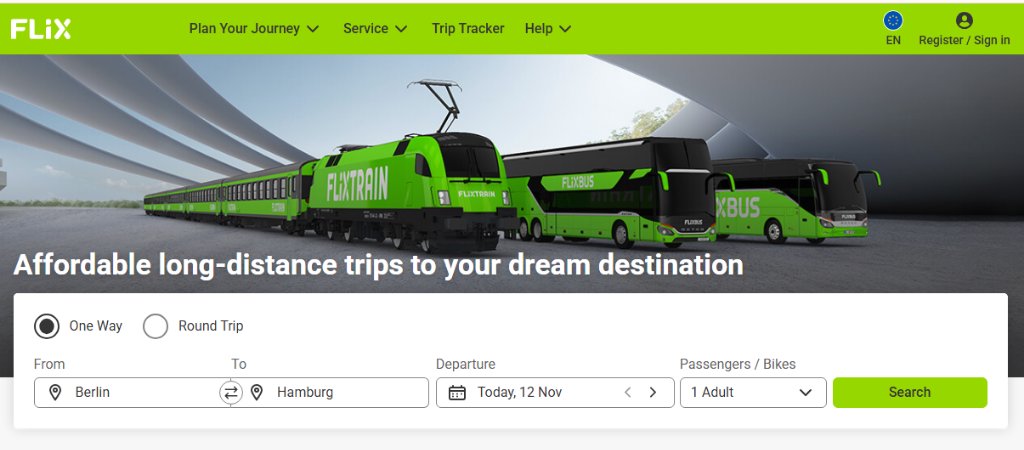
Flix // Affordable Long-Distance Travel
Flix unified travel-tech interface featuring intercity bus and train journey search across destinations, departure dates, and passenger bookings.Source: Flix Official Portal
2. Business Model: Understanding the Asset-Light Marketplace
One of Flix's most important business decisions is its asset-light operating model.
In a traditional bus business, a company generally needs to invest in buses, maintenance facilities, drivers, insurance, fuel and operational infrastructure.
Flix follows a different approach.
It focuses on building the technology and commercial network while working with regional bus operators that provide the vehicles and carry out transportation.
A. How the Asset-Light Model Works
The business model divides responsibilities between Flix and its operating partners.
Flix manages:
Brand identity and marketing.
Digital booking platforms.
Ticketing and payment systems.
Route and network planning.
Dynamic pricing.
Demand forecasting.
Customer experience.
Quality management and operational oversight.
Technology development.
Regional bus operators manage:
Ownership or provision of buses.
Drivers and operating personnel.
Daily transportation services.
Vehicle maintenance.
Fuel and other operational requirements.
Compliance with applicable transport regulations.
Delivery of the agreed transportation service.
This arrangement allows Flix to expand its network without purchasing every bus operating under its brand.
Consider a regional bus company that operates several buses between Delhi and Jaipur.
The company already has vehicles, drivers and experience managing daily highway schedules, permits and maintenance on that corridor. However, selling every seat independently often relies on local ticket agents, inconsistent digital visibility and price competition.
By partnering with Flix, the regional operator keeps control of its buses and staff while connecting to Flix's technology, branding and customer acquisition engine. Under the partnership agreement, designated coaches adopt standardized FlixBus livery and quality requirements, while seats are listed directly on the FlixBus website and mobile app alongside live route schedules.
Ticket revenue is typically shared between Flix and the bus partner under contractual settlement terms. Flix handles online distribution, customer support and dynamic pricing optimization to improve seat occupancy, allowing the regional operator to focus on safe, reliable day-to-day driving operations.
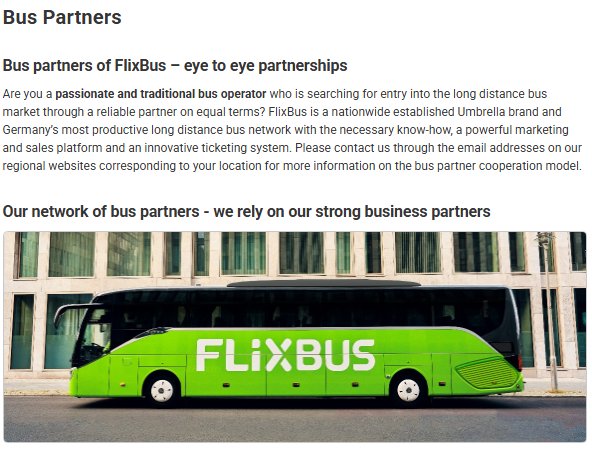
FlixBus // Bus Partner Ecosystem
FlixBus Bus Partners overview highlighting eye-to-eye partnerships with traditional bus operators across marketing, ticketing, and operations.Source: FlixBus Partner Network
3. Technology Infrastructure, Dynamic Pricing and Digital Booking
Because Flix operates as a travel-tech platform rather than an ordinary fleet owner, software systems sit at the center of route planning, pricing and passenger self-service.
A. Centralized Route and Network Planning
Traditional intercity bus networks often grow in disconnected regional clusters. Flix uses demand data, historical travel patterns and seasonal mobility analytics to design interconnected corridors and transfer hubs.
Instead of planning routes purely by intuition, network planning teams evaluate:
Passenger origin-destination search demand across cities.
Optimal departure frequencies and turnaround windows.
Multi-leg transfer timing between bus routes and rail links such as FlixTrain.
Airport shuttle integration connecting major terminals with city centers.
This data-led planning turns independent regional operators into one unified timetable covering thousands of stops across Europe, the Americas and Asia.
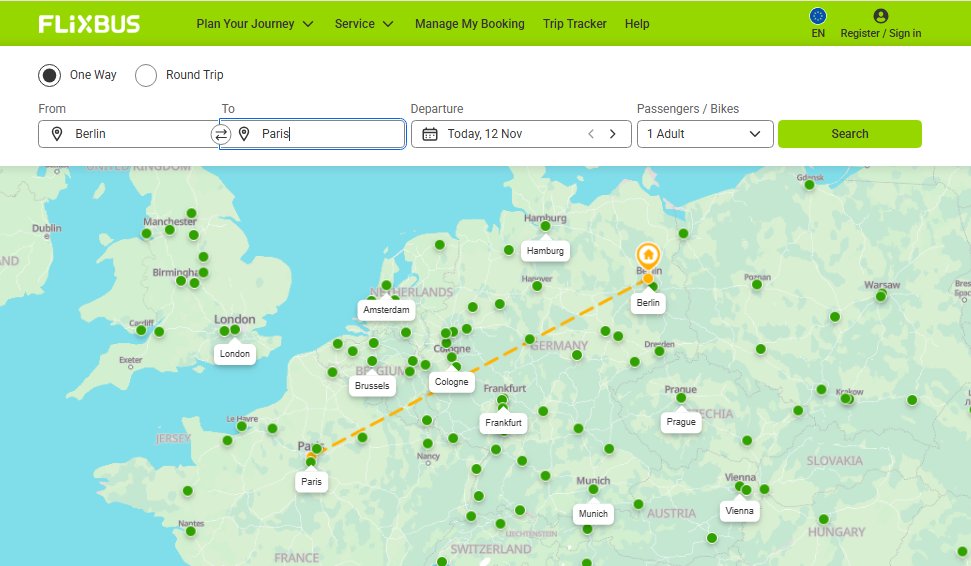
FlixBus // Interactive Network Planner
FlixBus journey planner mapping connected European hubs across Berlin, Paris, London, Amsterdam, Brussels, Frankfurt, Munich, Prague, and Vienna.Source: FlixBus Route Map
B. Dynamic Pricing and Yield Management
A core technology pillar behind FlixBus is dynamic pricing, similar in concept to airline yield management.
Rather than selling every seat on a route at a static fixed tariff, Flix's pricing algorithms continuously adjust ticket prices based on real-time market signals:
Booking lead time: Early bookings typically unlock lower promotional fares, while last-minute seats rise as departure approaches.
Seat occupancy levels: As more seats fill on a departure, remaining inventory shifts into higher price brackets.
Day and time demand: Weekend peaks, holidays and commuter rush hours carry different fare curves than mid-week off-peak departures.
Route competition and seasonality: Pricing models account for competing rail, carpool or regional bus alternatives.
This mechanism helps regional bus partners maximize revenue per trip while keeping base fares accessible for budget-conscious travellers on airport shuttles and long-distance corridors alike.
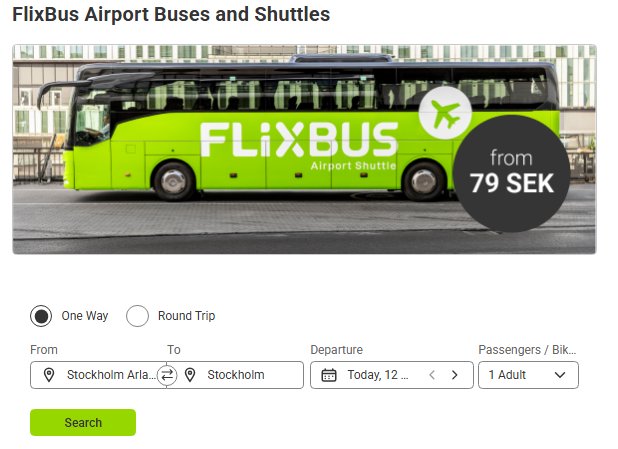
FlixBus // Airport Transfers & Pricing
FlixBus airport transfer service showing dynamic entry pricing (such as Stockholm Arlanda to Stockholm from 79 SEK) integrated into the core booking engine.Source: FlixBus Airport Shuttles
C. Digital Booking and Self-Service Management
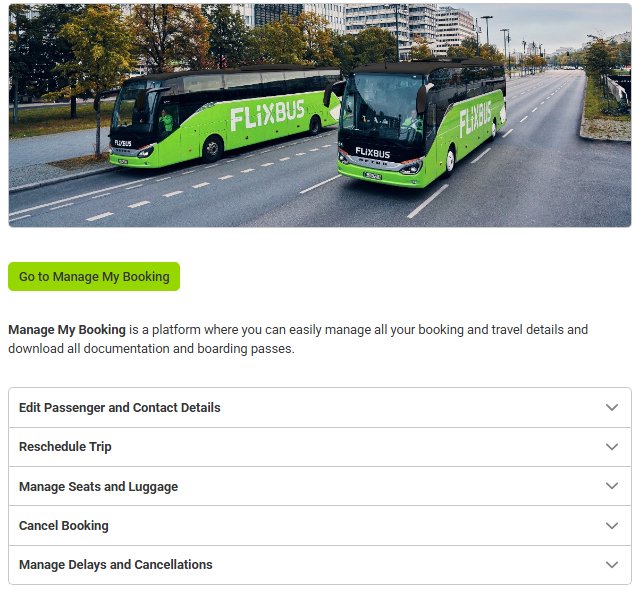
Once a ticket is purchased, passengers manage nearly every step of their itinerary online and download all travel documentation and boarding passes without visiting physical ticket counters.
Through the Manage My Booking portal, travellers can:
Edit passenger and contact details.
Reschedule trips when travel dates change.
Manage seats and luggage allowances.
Cancel bookings according to fare conditions.
Manage delays and cancellations digitally.
Automating routine booking modifications reduces support bottlenecks and gives customers predictable control over long-distance itineraries.
4. Real-Time Tracking, Mobile Experience and On-Board Services
Consistent passenger experience is crucial when hundreds of independent bus partners operate under a single green brand. Flix relies on real-time telemetry, mobile apps and clear service standards to keep journeys uniform.
A. Real-Time Trip Tracker and Live Telemetry
Waiting at an intercity bus stop without schedule visibility creates uncertainty for travellers. Flix addresses this with its dedicated Trip Tracker, powered by live vehicle GPS data.
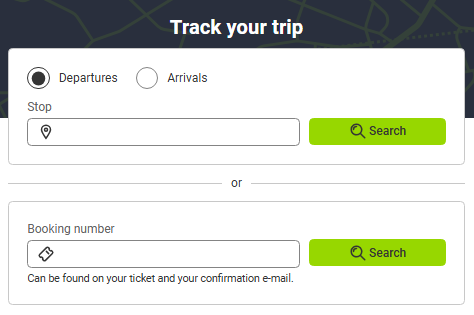
Passengers can check real-time bus status in two ways:
By stop location: Search departures or arrivals at a specific station or pickup point.
By booking number: Enter the reservation code from a confirmation email or ticket to view live bus progress and delay notifications.
Real-time arrival estimates also help operations teams detect corridor bottlenecks and send proactive delay alerts before passengers reach the terminal.
FlixBus // Real-Time GPS Tracking
FlixBus Trip Tracker interface supporting live departure and arrival lookups by station stop or individual booking reference.Source: FlixBus Trip Tracker
B. Mobile App Ecosystem and Paperless Boarding
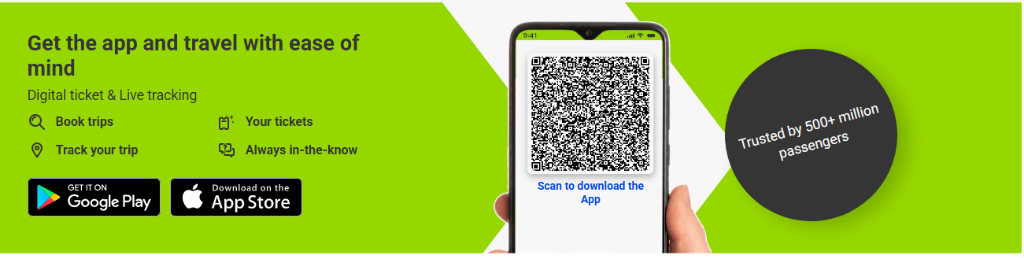
The FlixBus mobile application—trusted across 500+ million passenger journeys on iOS and Android—brings trip booking, digital tickets and live tracking together in one companion interface.
Key digital travel capabilities inside the app include:
Book trips: Search intercity routes and complete reservations directly from your phone.
Your tickets: Instant digital boarding passes without printing paper tickets.
Track your trip: Live bus status and trip monitoring inside the mobile interface.
Always in-the-know: Real-time alerts for schedule updates, platform info and travel changes.
FlixBus // Mobile App & Digital Tickets
FlixBus mobile platform offering digital QR tickets, live trip tracking, and seamless booking trusted by 500+ million passengers.Source: FlixBus Mobile App
C. Standardized Fleet and On-Board Amenities
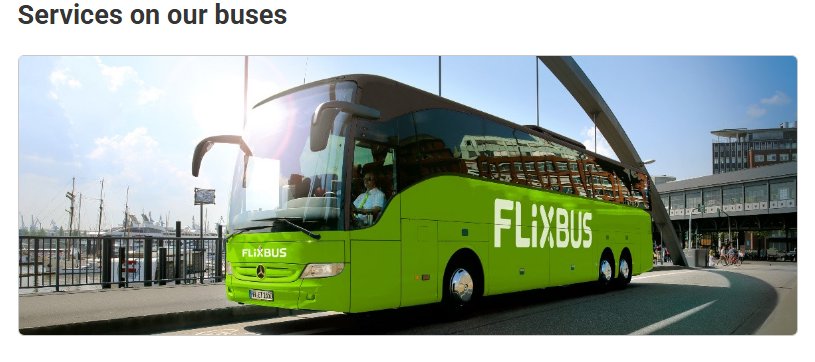
Even though vehicles are owned and operated by local partners, passengers expect consistent standards whenever they board a FlixBus coach.
FlixBus // Intercity Coach Service
Signature green FlixBus intercity coach operated by regional transport partners under standardized fleet quality guidelines.Source: FlixBus Fleet Standards
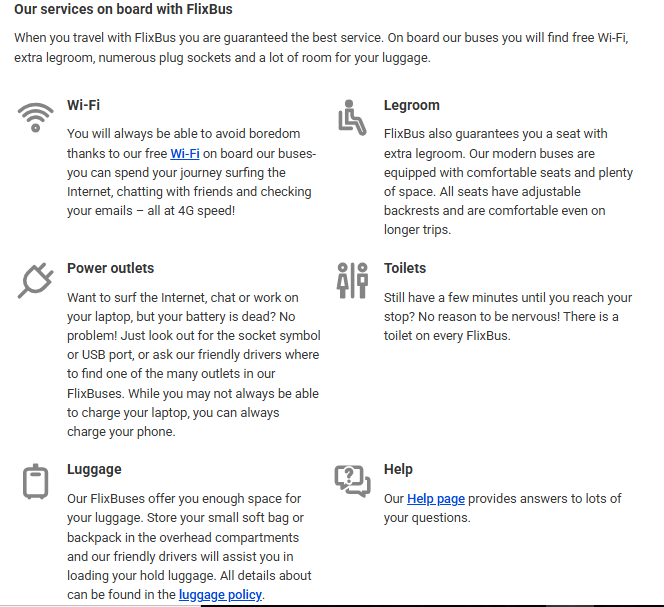
Standardized on-board services across eligible routes include:
Free Wi-Fi: Complimentary wireless internet access at 4G speed on board equipped coaches.
Extra legroom: Modern coaches equipped with adjustable backrests and generous seat spacing.
Power outlets: Seat-side sockets and USB ports for charging mobile phones (and laptops where supported) in transit.
On-board toilets: Restroom facilities available on every FlixBus coach.
Luggage allowance: Overhead compartments for small soft bags or backpacks plus hold compartments for larger suitcases.
FlixBus // On-Board Amenities
Overview of standard FlixBus passenger amenities including free Wi-Fi, extra legroom, power outlets, on-board toilets, luggage space, and help resources.Source: FlixBus On-Board Services
5. International Expansion Strategy: From Europe to India
Flix's asset-light marketplace enabled rapid international growth across multiple continents without requiring massive upfront capital to purchase thousands of coaches in every new country.
Key pillars of Flix's global rollout include:
European Consolidation: Expanding across Germany, France, Italy, Poland, Scandinavia, the UK and Central Europe while integrating FlixTrain rail services.
North American Expansion: Growing across the United States, Canada and Mexico—strengthened significantly through the acquisition and platform integration of Greyhound.
Regional Acquisitions: Integrating Kâmil Koç in Türkiye and expanding across Latin American corridors including Brazil and Chile.
India Launch (February 2024): Entering India's fragmented, high-volume intercity bus market through local bus operator partnerships rather than owning a domestic fleet outright.
In India, intercity bus travel moves millions of passengers daily across routes such as Delhi–Jaipur, Delhi–Chandigarh, Delhi–Dehradun and northern hill corridors. By offering regional operators modern fleet branding, digital ticketing, standardized safety checks and dynamic pricing software, Flix applied the same European travel-tech playbook to one of the world's largest road-transport markets.
FlixBus // Worldwide Country Network
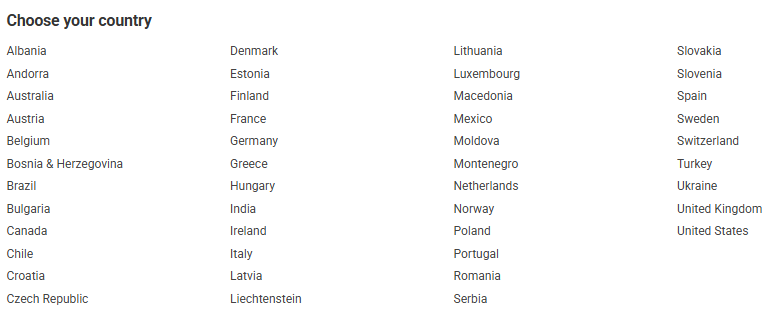
Country coverage matrix spanning Europe, the United States, Canada, Mexico, Brazil, Chile, Türkiye, Australia, and India.Source: Flix Global Footprint
6. Advantages and Challenges of FlixBus's Model
Advantages
Asset-light scalability: Flix can enter new cities and countries quickly without heavy capital expenditure on buses, depots and direct driver payroll.
Unified passenger experience: Travellers book different regional operators through one consistent website, mobile app, ticket format and brand standard.
Data-driven pricing and routing: Centralized algorithms optimize departure times and dynamic fares more effectively than small isolated bus companies.
Partner empowerment: Local bus operators gain global marketing reach, higher load factors and steady online bookings without building their own tech teams.
Service consistency across partners: Because third-party operators own the coaches and employ drivers, maintaining uniform cleanliness, punctuality and staff behaviour requires constant auditing.
Thin operating margins: Intercity bus travel competes aggressively on low fares alongside railways, state transport corporations and regional competitors.
External road and weather delays: Highway congestion, border checks and seasonal weather disruptions affect punctuality regardless of software optimization.
Aggregator and OTA competition: In markets such as India, platforms like redBus and AbhiBus already command massive digital ticket distribution, requiring Flix to build direct brand preference.
Partner retention: Balancing commission and revenue-share economics so local bus operators remain profitable across fluctuating fuel prices is an ongoing challenge.
7. Getting Started with FlixBus
For passengers planning a trip, booking with FlixBus takes only a few steps:
Visit the FlixBus website or open the mobile app and enter your departure city, destination and travel date.
Compare departure times, travel durations, bus stops and dynamic ticket prices.
Choose optional add-ons such as seat selection or extra luggage if required.
Complete payment online to receive your instant digital QR ticket.
Track your coach prior to departure using the Trip Tracker and board using your mobile pass.
For regional transport companies interested in partnering, operators can apply through Flix's Bus Partners portal to connect existing fleets with FlixBus's network planning, branding and global ticketing infrastructure.
Conclusion
FlixBus shows how an asset-light technology layer can modernize a traditional, capital-intensive industry like long-distance road transport.
Rather than competing with regional bus companies strictly by buying bigger fleets, Flix built a two-sided travel-tech ecosystem. Local operators contribute vehicles, drivers and route execution, while Flix provides centralized demand forecasting, dynamic pricing algorithms, GPS trip tracking, digital ticketing and a recognizable global brand.
From its start in Germany in 2013 to Greyhound in North America and its expansion into India in 2024, Flix's growth highlights how software infrastructure, strategic partnerships and standardized customer experience can scale affordable intercity mobility worldwide.
// DEPLOYMENT_RECOMMENDATIONS & TRADE_OFFS
Production Implementation Takeaways
Every architectural decision in Technology involves explicit engineering trade-offs between raw compute cost, throughput guarantees, and operational maintenance friction. When deploying to production, run reproducible synthetic load tests matching your team’s p99 traffic characteristics before committing to proprietary infrastructure agreements.
Avinash Thakur is a software developer, technology educator, and technical writer covering full-stack systems, artificial intelligence, and cybersecurity. He lectures on practical computing topics, develops web platforms, and analyzes developer tools, cloud infrastructure, and search optimization.
Complete guide to Fiverr: how $5 Gigs evolved into Fiverr Pro, AI tools and MCP integration, seller & buyer fees, payment protection, and Fiverr vs. Upwork.
A complete guide to Alibaba.com B2B sourcing, Verified Suppliers, Trade Assurance escrow, Cainiao global logistics, Alibaba Cloud infrastructure, and modern supply chains.